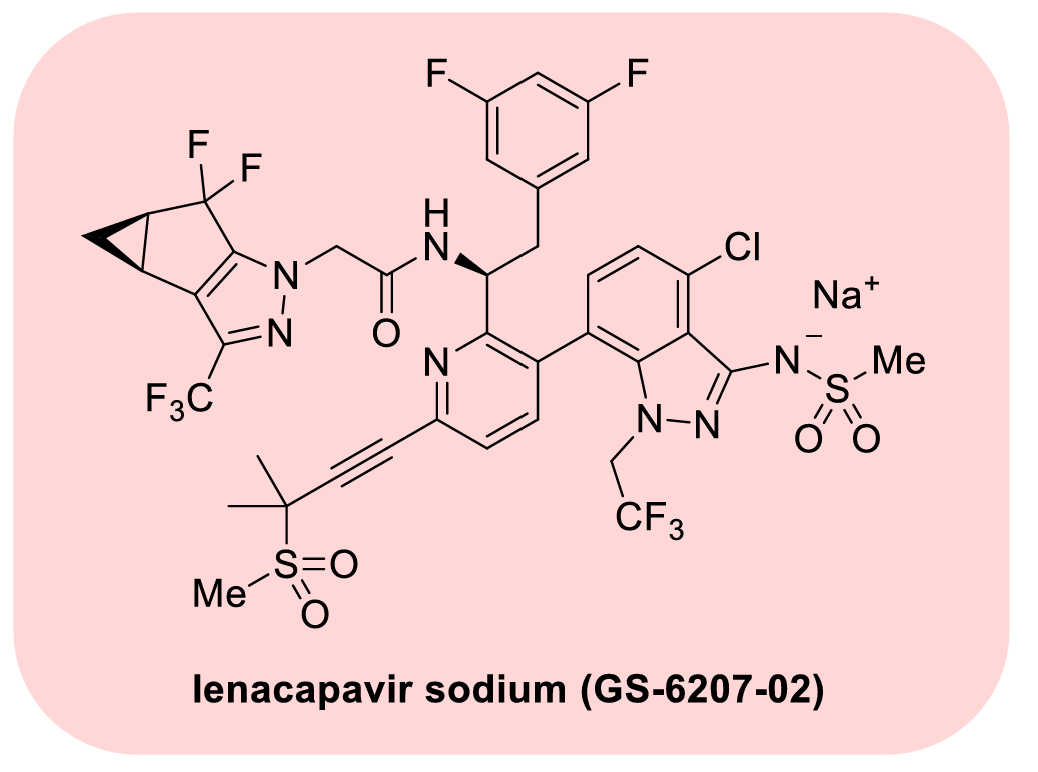
The first HIV-1 capsid inhibitor. It binds between capsid protein subunits and breaks several stages of replication at once, so it works against virus resistant to every other class. Its potency and very low clearance are what make a twice-yearly subcutaneous injection possible: as Sunlenca for multidrug-resistant infection, and as Yeztugo and Yeytuo for pre-exposure prophylaxis. In September 2025 agreements with Indian manufacturers set a price of about 40 US dollars per patient per year for 120 low- and middle-income countries, which is why how it is made now matters a great deal.
HIV-1 capsid (p24) inhibitor, first in class
EU Aug 2022; FDA Dec 2022 (Sunlenca); FDA Jun 2025 (Yeztugo, PrEP)
C39H32ClF10N7O5S2 · 968.28 g/mol
CAS 2189684-44-2
The four-step final assembly
4 stages · 100 kg+ per batch · no protecting groups
Lenacapavir is built convergently from four fragments that are made separately, then joined. This is the assembly: a bis-bromopyridine core carrying the chiral amine is alkynylated at one bromide, acylated with the chiral pyrazole acid, cross-coupled at the other bromide with the aminoindazole boronic ester, and finally bis-methanesulfonylated and selectively hydrolysed to the sodium salt. The medicinal chemistry route used a Boc group and made five atropisomeric intermediates; this one uses none and makes two. Every step ends in a crystallisation that was developed on purpose, which is what let the process run at hundred-kilogram scale with palladium at single-digit ppm.
Scale: 100 to 130 kg of isolated solid per step
no public CAS
+
no public CAS
Step 188%, 100 kg
Pd(PPh3)2Cl2 (1.5–3 mol%), NEt3 (5 equiv), MeCN, 70 °C, 6 h then N-acetyl-L-cysteine, then water as antisolvent
a copper-free Heck alkynylation, and the copper is the point · classical Sonogashira conditions gave Glaser homocoupling of the alkyne, and raising the copper loading made both conversion and purity worse · dropping CuI entirely and going from 50 to 75 °C restored 93% conversion · N-acetyl-L-cysteine in the reaction stream pulls palladium from 2789 ppm down to about 120, and the product then drops straight out on adding water
no public CAS
no public CAS
+
no public CAS
Step 291.5%, 129 kg
T3P (50% in DMF, 1.5 equiv), NEt3 (1.5 equiv), MeCN, 20 °C, 3 h then DMF and water, seeded, water as antisolvent
the amide coupling, chosen for what it leaves behind · EDC and HOBt worked, but the urea byproduct poisoned the palladium in the next step and had to be filtered off through silica · T3P is fast, needs only one equivalent of the expensive pyrazole acid, and its byproducts are tolerated downstream · the isolation oiled out until the DMF content was raised from 1.1 to 2.1 mL/g before the water went in
no public CAS
no public CAS
+
no public CAS
Step 386.3%, 100 kg
PdCl2 (2 mol%) + CyPPh2 (4 mol%), KHCO3 (3 equiv) 2-MeTHF / water, 68 °C, 15 h; isolated as the bis-mesylate EtOH solvate
the Suzuki that forms the hindered biaryl, and the crystallisation that does the resolving · the free base is a roughly 4:1 mixture of atropisomers that equilibrates in solution, but only one of them crystallises as the bis-methanesulfonate alcohol solvate, so the isolation purifies the atropisomer as well as the compound · PdCl2 with a cheap monophosphine replaced Pd(PCy3)2Cl2 and removed a long diatomaceous earth filtration · ethanol in the aqueous wash stops the emulsions that otherwise halve the palladium purge
no public CAS
no public CAS
Step 490.3%, 130 kg
MsCl (3 equiv), NEt3 (6 equiv), 2-MeTHF, 10 °C, 1 h then aq. NaOH (3.5 equiv), 35 °C, 2 h; EtOH / n-heptane crystallisation
two sulfonyl groups on, one off · mono-sulfonylation stalled at 90% and could not be pushed, so the process puts both on and then hydrolyses one back off, which goes cleanly · three impurities had to be designed out: ethyl methanesulfonate alkylating the product when ethanol was carried in from the previous solvate, chloromethanesulfonyl chloride contaminating commercial MsCl, and 5-hydroxy-2-pentanone accumulating in recycled 2-MeTHF and quietly capping the amine so the reaction appeared to stall
none protecting groups vs one, in the med-chem route3 ppm palladium in the penultimate vs 392 ppm, first generation-18% process mass intensity vs first generation99.9% final purity vs by UPLC, 130 kg batch
Figures from the second-generation process against the first. Process mass intensity fell 66% for the alkynylation, 36% for the amide coupling and 22% for the Suzuki; the final step was not reduced, because the extra washes and distillations needed to control impurities were judged worth the mass.
Wagner, A. M.; Bonderoff, S. A.; Chang, S.; Deignan, J.; Esanu, M. M.; Van Huynh, H.; Niu, T.; Ngo, V.; O'Keefe, B. M.; Phoenix, J.; Rainey, T. J.; Roberts, B. J.; Shen, J.; Stewart, C.; Vandehey, A. L.; Wolckenhauer, S. A.; Wong, C. Y.; Yarmuch, B. H.
Synthesis of Lenacapavir Sodium: Active Pharmaceutical Ingredient Process Development and Scale-up
Org. Process Res. Dev. 2024, 28, 3382–3395 · Scheme 2 and Schemes 3–7, Tables 1–6
What is actually isolated: lenacapavir sodium (GS-6207-02). The methanesulfonamide on the indazole is deprotonated and the counter-ion is sodium, which is why the label states 300 mg of lenacapavir as 306.8 mg of the sodium salt. The structures drawn in the steps above are the free form. Note also the hindered biaryl bond between the pyridine and the indazole: it rotates slowly enough that the molecule exists as two atropisomers interconverting with a half-life of about an hour in solution, roughly 4:1, and the drug was developed as the mixture.
The aminoindazole fragment, five steps
5 stages · 35% overall · 128 kg per batch
One of the four fragments is hard enough to deserve its own paper. The aminoindazole boronic ester that supplies the right-hand side of the molecule is made in five steps from a cheap dihalobenzene: ortholithiation and formylation, oxime formation and dehydration to the nitrile, cyclisation with hydrazine onto the indazole, N-alkylation with trifluoroethyl triflate, and Miyaura borylation. The second-generation process lifted the overall yield from 23% to 35% and the palladium down from 3405 ppm to under 10, which matters because palladium carried in on this fragment was what made the Suzuki coupling in the assembly route behave inconsistently.
Scale: 128 to 358 kg input per step
no public CAS
Step 184–86%, 135 kg
iPr2NH / n-BuLi (1.1 equiv), THF, −30 °C, then DMF (2 equiv) quenched into aq. HCl; DMF / n-heptane / water crystallisation
ortholithiation between the two halogens, trapped with DMF · two impurities drove the development: the benzyl alcohol, from moisture, which thorough reactor drying cut below 1%; and an o-dimethylamino aldehyde formed when dimethylamine released from DMF during the quench displaced the fluoride, which slow addition of 18% HCl over three hours holds below 2%
no public CAS
no public CAS
+
Step 291–93%, 230 kg
NH2OH·HCl (1.1 equiv), Ac2O (2.2–2.5 equiv), AcOH, 75–85 °C, 12 h water as antisolvent, direct-drop crystallisation
aldehyde to nitrile through the aldoxime, with the dehydrating agent chosen on safety grounds · hydroxylamine-O-sulfonic acid did this in one operation but became unsupplyable · formic acid pressurised the reactor by decomposing, sulfuric acid in DMAc risked thermal runaway, and cyanuric chloride reacts exothermically with DMF after an induction period · acetic anhydride at 2.2 equivalents gives 99% conversion at a lower temperature than any of them
no public CAS
no public CAS
+
no public CAS
Step 395%, 376 kg
20% aq. hydrazine hydrate (2 equiv), NaHCO3 (1 equiv) water / IPA 1:1, 80 °C, 18–28 h; reactive crystallisation
the indazole closes as the product crystallises out · three safety and engineering problems solved at once: concentrated hydrazine decomposes exothermically from 160 °C, so it is diluted to about 13% to raise the onset; the fluoride released makes HF, which attacks glass, 316L steel and Hastelloy alike, so sodium bicarbonate is added to neutralise it and glass-lined reactors can be used; and the product oiled in water/ethanol, so water/isopropanol was used instead
no public CAS
no public CAS
+
no public CAS
Step 466%, 297 kg
trifluoroethyl triflate (1.05 equiv), K3PO4 (1.55 equiv), DMF, 30 °C, 3 h water direct-drop, then recrystallised from DMF / HCl
three nitrogens, one of which you want · the N-2 regioisomer forms at about a third regardless of solvent, temperature, base or electrophile, so the process accepts it and purges it, having first cut the over-alkylated impurities by lowering the reagent charge · potassium phosphate replaced caesium carbonate for storage and cost, at a seventh of the price · the DMF/HCl recrystallisation also removes inorganic salts, which otherwise cause protodehalogenation in the borylation
the borylation, and a lesson about a hygroscopic base · potassium acetate starts absorbing water at 20% relative humidity and deliquesces on the bench, and just 0.1 equivalent of water generated 12% of the des-bromo impurity · potassium propionate is less hygroscopic and gave the lowest impurities · a design-of-experiments study then found an interaction nobody had expected, between base charge and temperature, which mapped a window at 85–105 °C · the crystallisation only behaved once n-heptane was added to isopropanol, where the mixture dissolves the product better than either solvent alone
no public CAS
35% overall yield vs 23%, first generation<10 ppm palladium in the product vs 3405 ppm99.9 wt% assay vs 94.7 wt%HOSA hazardous reagent removed vs replaced by NH2OH/Ac2O
Second generation against the initial manufacturing route. Hydroxylamine-O-sulfonic acid was abandoned not for chemistry but for supply: new vendor lots assayed below 45 wt% against 83 wt% before, and carried enough hydroxylamine degradant to throw 12–35% of the aldoxime.
Lin, L.; Wagner, A. M.; Davy, J.; Wong, C. Y.; Chang, W.-T. T.; O'Keefe, B. M.; Goldberg, A. F. G.; Van Huynh, H.; Sun, H.; Wang, W.; Wolckenhauer, S. A.
Synthetic Development and Scale-Up of the Aminoindazole Fragment of Lenacapavir
Org. Process Res. Dev. 2026, accepted 15 September 2026 · Schemes 2–8, Tables 1–4

 no public CAS
 no public CAS
 no public CAS
 no public CAS
 no public CAS
 no public CAS
 no public CAS