An orally bioavailable microtubule-targeting agent that binds the colchicine site on tubulin, so it is not pumped out by P-glycoprotein and keeps working where taxanes have stopped. It has been through a phase Ib/II study in metastatic castration-resistant prostate cancer and a phase III study in hospitalised COVID-19 patients, and Veru has announced plans for a phase II study in metastatic pancreatic cancer. It is not approved anywhere.
Tubulin polymerisation inhibitor, colchicine-binding site
Not approved; phase II/III investigational
C21H19N3O4 · 377.39 g/mol
CAS 1332881-26-1
Chromatography-free route via an acylaminoisoxazole
8 stages · 31% overall · no column at any stage
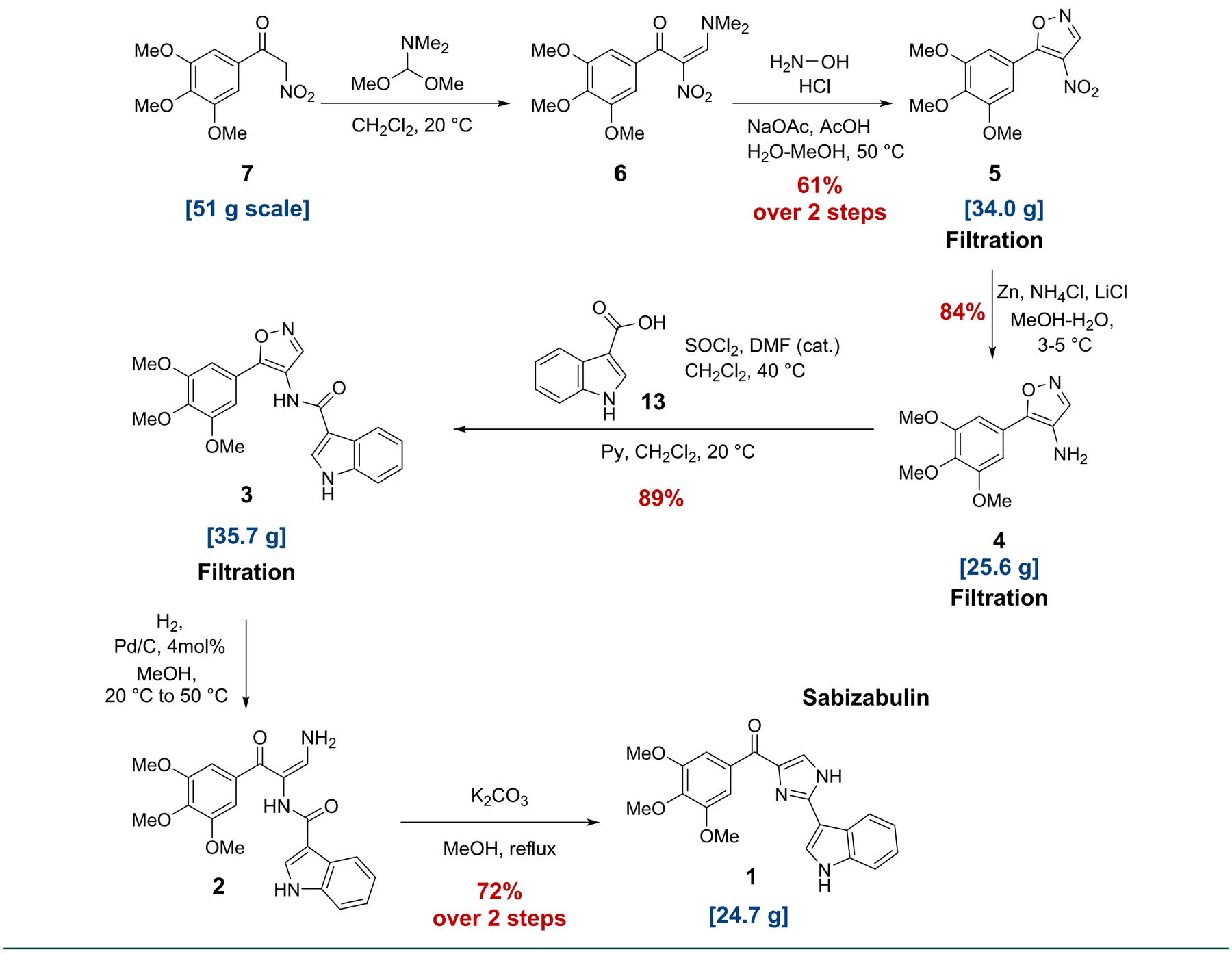
The imidazole in sabizabulin is the hard part. Earlier routes built it directly and paid for it: one needed t-BuLi at −78 °C and finished at 0.4% overall, another ran ten steps with OsO4 and three protecting-group operations for 3.8%. This process never builds an imidazole at all. It builds an isoxazole instead, early and cheaply from a nitroketone, carries it through the whole sequence as a masked imidazole, and unmasks it at the end: hydrogenation snaps the weak N-O bond to give an enaminone, which closes onto the amide nitrogen to form the imidazole ring. Nothing is protected, nothing is chromatographed, and every intermediate is isolated by filtration or crystallisation. The first two steps here are Scheme 3 of the paper, the rest is Scheme 9.
Scale: 74.3 g of the starting acid; 51 g of nitroketone into the second half; 24.7 g of sabizabulin out
+
Step 198% isolated
SOCl2 (3 equiv), DMF (cat.), CH2Cl2, 40 °C, 2 h then imidazole (1 equiv), Et3N (1 equiv), CH2Cl2, 0 to 20 °C
the acid is activated as an acylimidazole, not as the acid chloride · imidazole was chosen over benzotriazole or a phenyl ester because imidazole is water soluble, so the excess simply washes out · no column, 90 g from one flask
no public CAS
no public CAS
+
Step 298% isolated
MeNO2 (1.2 equiv), t-BuOK (1.2 equiv), DMSO, 10-20 °C, 4 h then quench into ice, water and HCl
C-acylation of nitromethane · the potassium nitronate is made first at 16-18 °C, then the solid acylimidazole is added in one portion · quenching into ice and acid precipitates the product, so it is filtered rather than extracted · use the acylimidazole immediately, it hydrolyses slowly even at 4 °C
no public CAS
no public CAS
+
Step 377% by mass, used crude
DMF-DMA (1.5 equiv), CH2Cl2, 20 °C, 30 min then crystallised by adding methanol
dimethylaminomethylenation, and the first place the process earns its keep · the side product is methyl 3,4,5-trimethoxybenzoate, which stays dissolved in methanol while the enaminone crystallises out · removing that ester matters: leave it in and the next step's yield drops, while the coloured impurities alongside it turn out to be harmless
no public CAS
no public CAS
Step 461% over two steps, 34.0 g
NH2OH·HCl (1.2 equiv) added over 20 min NaOAc/AcOH buffer at pH 5.5, H2O-MeOH 3:1, 50 °C
the isoxazole ring, and the step that needed the most work · the starting material decomposes in acid and the product decomposes in base, so the window is narrow: yield peaks at pH 5.2-5.6 and falls away on either side · the hydroxylamine goes in as a solution, dropwise, into a pre-equilibrated buffered suspension, which avoids local pH excursions · homogeneous solvent only, because a two-phase mixture cannot be buffered properly
no public CAS
no public CAS
Step 584%, 25.6 g
Zn (4.5 equiv), NH4Cl (10.7 equiv), LiCl (1 equiv) MeOH-H2O, 3-5 °C, then warm to room temperature
nitro to amine on an intact isoxazole · temperature is the whole story: at 20-30 °C the exotherm drives side products and the yield sits at 63%, at 0-5 °C it reaches 85% · lithium chloride adds about ten points on its own · the product is filtered off through Celite with the zinc salts and then washed off the cake with dichloromethane, which is what replaces the column
no public CAS
no public CAS
+
Step 689%, 35.7 g
indole-3-carboxylic acid (13) + SOCl2, DMF (cat.), CH2Cl2, 40 °C then the amine with pyridine (1.15 equiv), CH2Cl2, 20 °C, 1 h
the indole half is joined on as an acid chloride · pyridine rather than triethylamine or DIPEA, because a stronger base opens the isoxazole ring · dichloromethane is a poor solvent for hydrogen-bonded aggregates, so the amide precipitates during the aqueous workup and is simply filtered
no public CAS
no public CAS
Step 797% assay-corrected, used crude
H2 (1 atm), 10% Pd/C (4 mol%), EtOH 20 °C for 2 h, then 50 °C for 30 min
the mask comes off · hydrogenolysis breaks the weak N-O bond of the isoxazole and nothing else, revealing the enaminone that will become the imidazole · balloon pressure is enough · the crude product is carried straight into the last step, which is the point of doing it this way round
no public CAS
no public CAS
Step 872% over two steps, 24.7 g
K2CO3 (30 equiv), MeOH, reflux, 8 h, 0.025 M then crystallised as the methanol solvate
the imidazole closes · two numbers decide this step and both are unusual: thirty equivalents of carbonate, and a dilution of 0.025 M · at 0.1 M the yield is 42%, at 0.025 M it is 72%, because the competing reaction is methoxide cleaving the enaminone apart into indole-3-carboxamide and trimethoxybenzoate · stronger bases work but destroy the substrate, organic bases do not work at all · the final purification is a crystalline methanol solvate that barely dissolves in methanol while the impurities do
31% overall yield vs 0.4 to 15.9%none chromatography vs every earlier routenone protecting groups vs two of three routes99.2% final purity vs by LC-UV
Against the three published routes the authors tabulate: Chen (5 steps, 0.4%), Wang (10 steps, 3.8%) and Peng (5 steps, 15.9%). All three require chromatography; the first two also require protecting groups. Yields here are isolated.
Adaeva, O. I.; Demchuk, D. V.; Semenov, V. V.
A Practical and Chromatography-Free Process for Sabizabulin (VERU-111) via an Acylaminoisoxazole Intermediate
Org. Process Res. Dev. 2026, accepted 21 October 2026 · Schemes 3 and 9, Tables 3-5
The second half of the route in one picture, as the paper draws it (Scheme 9): nitroketone 7 through the enaminone, the nitroisoxazole, the aminoisoxazole and the amide to sabizabulin, with the isolated mass at each stage. Every intermediate marked "Filtration" came out of the reaction as a solid. Reproduced from the paper cited below.


 no public CAS

 no public CAS

 no public CAS
 no public CAS
 no public CAS

 no public CAS
 no public CAS