Chem2Cure Research and Therapeutics

Molecule of the Month · November 2026

Artemisinin

Its derivatives artesunate and artemether are used in clinics

A plant remedy, a peroxide bridge, and a Nobel Prize.

Type
Antimalarial, a sesquiterpene lactone with a peroxide bridge
Source
Sweet wormwood, Artemisia annua
Isolated
1972, by Tu Youyou's team in China
Used for
Malaria caused by Plasmodium falciparum, always in combination
Share

The story

In the late 1960s, a Chinese research programme known as Project 523 set out to find new malaria drugs. Tu Youyou and her team went through old medical texts and tested plant extracts. A text from the fourth century pointed to sweet wormwood, and, by Tu's account, to soaking the herb instead of boiling it. A low-temperature extraction worked where hot extraction had failed.

In 1972 her team isolated the active compound, now called artemisinin. Tu received the 2015 Nobel Prize in Physiology or Medicine, sharing it with William Campbell and Satoshi Omura.

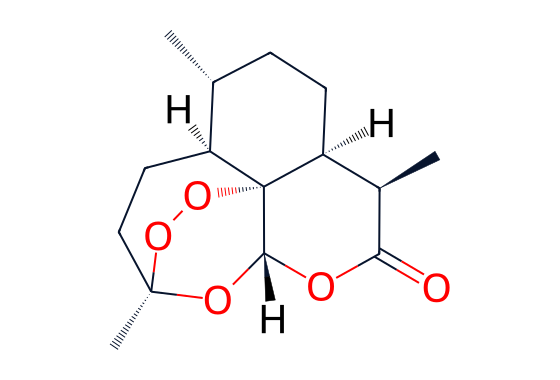
Artemisinin has an unusual feature: a peroxide bridge, an O-O bond, inside a cage of rings. Drugs rarely contain peroxides because they are reactive. Here the bridge is essential, and without it the activity is lost. It is thought to be broken by iron from the heme that the parasite releases when it digests haemoglobin, producing reactive species that damage the parasite.

Artemisinin leaves the body quickly, so it is used today as derivatives such as artesunate and artemether, combined with a longer-acting partner drug. The World Health Organization recommends these combinations as first-line treatment for falciparum malaria.

What to look for in the 3D view

Look for the pair of red oxygen atoms bonded to each other near the middle of the cage. That O-O bond is the peroxide bridge. It is one bond long, and it is the whole mechanism. Notice also that there is no nitrogen anywhere in the molecule, and that it is a compact, rigid cage rather than a long chain.

What the design taught us

Three things worth noticing

Hard to grow, so make it differently

The plant gives a low and variable yield. In a semi-synthetic route, engineered yeast makes artemisinic acid, and chemists convert it to artemisinin.

Fixing the solubility

Artemisinin dissolves poorly in both water and oil. Chemists reduced it to dihydroartemisinin and attached groups to make artesunate, which dissolves in water, and artemether, which dissolves in oil.

A bond that breaks the rules

The Compound screener flags the peroxide as a problem group. It is also the reason the drug works. A flag is a question to ask, not a verdict.

Why it matters here

Most of Bangladesh's malaria is in the three Chittagong Hill Tracts districts, Bandarban, Rangamati and Khagrachari, and the country has set a goal of eliminating the disease by 2030. Artemisinin-based combination therapy is the standard treatment. Partial resistance to artemisinin has been reported in parts of Southeast Asia, including Myanmar, which borders Bangladesh, so keeping these drugs working matters close to home.

How discovery works

Questions to think about

  1. Artemisinin passes every drug-likeness limit in the screener, yet it has a reactive peroxide. What does that tell you about using rules of thumb to throw molecules away?
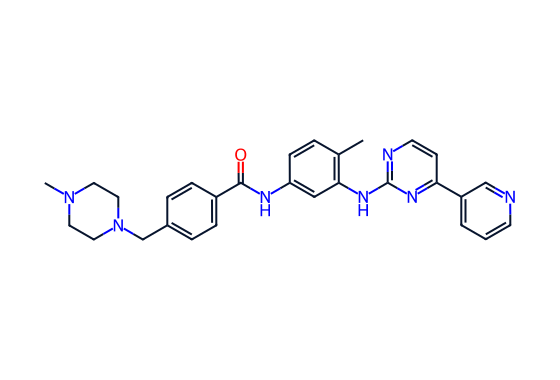
  2. Natural products often have many stereocentres. Artemisinin has seven. Why does that make a synthesis harder than for imatinib, which has none?

Not sure? Run it through the screener and compare. Or bring your answer to a Chem2Cure cohort.

Sources
  • Tu Y. The discovery of artemisinin (qinghaosu) and gifts from Chinese medicine. Nature Medicine 2011;17:1217-1220.
  • The Nobel Prize in Physiology or Medicine 2015, press release. nobelprize.org.
  • Paddon CJ et al. High-level semi-synthetic production of the potent antimalarial artemisinin. Nature 2013;496:528-532.
  • World Health Organization. Guidelines for malaria.

Written for learners, not as medical advice. Check the sources for details.

Molecule of the Month, November 2026: Artemisinin. A plant remedy, a peroxide bridge, and a Nobel Prize.
This is the card people see when the link is shared.
The moving version. Press play to see it.

Share Artemisinin

Know a student, a teacher or a colleague who would like this one? Send it on.

Facebook Messenger WhatsApp LinkedIn

A link on LinkedIn or Facebook always shows a still card. To show the molecule turning, post the video and put the link in the caption.

Stay in the loop

A new molecule on the first of every month, plus new tools and cheat sheets as they are ready. No spam, and you can leave in one click.