The story
Chronic myeloid leukaemia has one clear cause. In most patients, two chromosomes swap pieces, and the join creates a fused gene called BCR-ABL. It makes an enzyme, a kinase, that is stuck in the "on" position and keeps telling blood cells to divide.
Before imatinib, treatment meant chemotherapy or a bone marrow transplant, and most patients eventually reached a fatal stage of the disease. Imatinib was approved in 2001. In the IRIS trial, about nine in ten patients taking it were alive after five years.
It was not designed on a screen. Chemists at Ciba-Geigy, now Novartis, screened for compounds that blocked kinases and found a modest hit, a small phenylaminopyrimidine. Over several rounds of making and testing analogues, they made it stronger, more selective, and able to be absorbed when swallowed.
What to look for in the 3D view
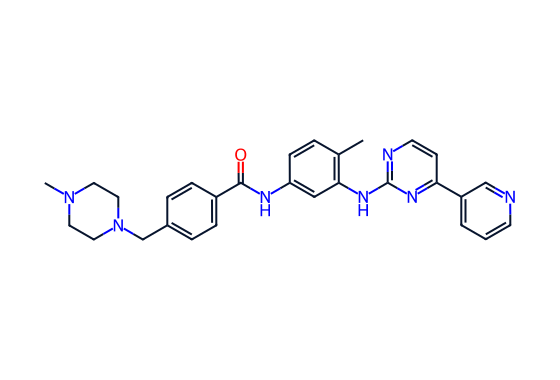
Look for the long, fairly flat shape. The pyridine and pyrimidine rings at one end are the head that sits in the enzyme. The piperazine ring at the other end is the soluble tail. It reaches to the edge of the pocket, where it is partly exposed to water. In the crystal structure, imatinib holds ABL in its inactive shape, which helps explain why it is so selective.